Betty Hahn Portfolios: Woodcuts, Gum Prints and Polaroids
Betty Hahn’s portfolios cover about five decades and show an artist who kept changing materials. Below is a guided tour of the main series, grouped roughly in the order they were made.
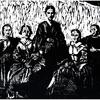
Early printmaking, 1964 to 1971
Woodcuts (1964 and 1965). These prints were cut from white pine and from boards that had once been used for drawing. The pictures draw on family snapshots and other found photographs, plus one daguerreotype and one tintype from the nineteenth century.
Commemoratives (1971). Hahn shrank 35mm negatives to roughly the size of a postage stamp and had them printed commercially as gelatin silver images, fifty to an 8×10 sheet. Each sheet was perforated like a sheet of stamps. The pictures mark events in her own life during that year.
Gum bichromate on paper (1965 to 1970). Negatives in 35mm and 120 roll-film formats were enlarged onto graphic arts film and contact printed. Some sheets received watercolour or fluorescent spray paint. Most are one-offs, though a few images were printed more than once.
Gum bichromate on fabric and miniature nudes (1965 to 1971). On cloth, the prints were finished with coloured embroidery thread. Subjects include portraits, landscapes, gardens, buildings, television images, fruit and vegetables. The 1971 miniatures are tiny two-inch squares, each showing a female torso holding a fruit or vegetable, with the print colour chosen to match the produce. Sixteen images make up the set, in editions of no more than ten.
Western imagery, 1974 to the 1990s
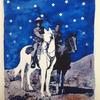
Lone Ranger series (1974 to 1979). Hahn found a Hollywood still in a stationery shop showing the Lone Ranger and Tonto on horseback in an Arizona desert, with a saguaro behind them. She reworked that single picture as cyanotypes, Van Dyke prints, gum bichromates, duotones, photo silkscreens and lithographs. Unique pieces carry additions such as watercolour, graphite, pastel, marker, silver paper stars and even instant coffee. Works in the series are generally 22 by 18 inches.
B Westerns. Monotypes combined with cyanotype, Van Dyke prints, photolithography, chine colle and pencil. The group grew out of the Lone Ranger work and takes its mood from low-budget Hollywood westerns.
Colour and travel
Passing Shots. A toy 126-cartridge camera, a gift from a photographic-equipment curator at the George Eastman House, produced these colour prints. So far 144 negatives from the United States, Spain, Portugal, Japan and Australia have been printed, showing birds, flowers, fish, animals and botanical gardens. Several were printed more than once.
Cut Flowers (1978 to 1989). Still lifes of arranged flowers made from 4×5 negatives, then printed as cyanotypes, Van Dyke prints, monotypes, lithographs, silkscreens and colour photographs. Pastel, acrylic, watercolour, marker, crayon and metallic paint were added by hand.
Shinjuku (1984). Eleven Ektacolor photographs measuring 17 by 24 inches, shot on two street corners in Tokyo’s Shinjuku district. They combine black-and-white and colour negatives with text written by the artist, and the shift between the two modes echoes the move from monochrome to colour in the film version of The Wizard of Oz.
Collect from Berlin (1991). Four photolithographs, each 27 by 36 inches, inspired by film noir. They were printed by Rodney Hamon at Black and Blue Press in Albuquerque.
Large-format Polaroids
Two 1982 projects were made on 20×24 Polaroid material. Ehrlichman Surveillance records a dinner at the Shidoni sculpture garden and foundry in Tesuque, New Mexico, held for visiting Chinese cultural attaches. White arrows point out John Ehrlichman, the former Nixon aide who served time for his part in Watergate. Crime in the Home has ten pictures: eight of household objects chewed up by the artist’s Borzoi puppy, Trotsky, a police-style sketch of the culprit, and a photograph of its paws beside a ruler.
Sequences about travel and sleep
Circumstances of Awakening: Berlin (1990). Filmstrip-like colour and silver images from 35mm negatives, including a sleeping man in a hotel room, a greenhouse and a poppy field.
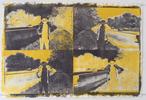
Arrival or Departure, After Hitchcock (1987). Gelatin silver frames of Ira Jaffe walking along the Albuquerque train platform with luggage, modelled on the opening of Hitchcock’s 1964 film Marnie.
Cuba, 2013
Titled Past Imperfect, this late project used a smartphone and several apps. Hahn spent eight days in Cuba in 2013 with a supervised group of tourists from Indiana, and the resulting prints measure 12 by 16 inches.
To see where these series have been shown, visit the exhibitions page, or read about the artist’s training and teaching on the biography page.